How to Use Golf Alignment Sticks [Setup and Practice Guide]
Use golf alignment sticks as visual references for your setup. Begin with a specific target, establish its direction on the ground, and use a second parallel reference to check your stance. The sticks make the intended arrangement easier to see. They do not force the club to follow a particular path or tell you why every shot curves.
I would start with a simple address-position check before adding ball-position references or more elaborate exercises. A pair of rods is enough to make the basic relationship clear, and you can practice establishing it without hitting a ball. Keep the equipment clear of the club and ball, and remove any rod from the strike area before making a stroke.
The method below covers a neutral ground-alignment setup, how to mirror it for a left-handed golfer, and a careful way to check ball position. It also explains what to observe afterward, so a useful reference does not become an excuse to make random changes to the swing.
Choose the Target Before Placing the Sticks
Stand behind the ball position and choose a distinct target for the exercise. A particular point is more useful than a broad instruction such as 'somewhere toward the far end of the range.' Titleist's aim-and-alignment guidance uses a specific distant target and an intermediate reference to establish the intended line before the golfer settles into address. Make that decision first rather than laying down a rod and searching for a target that happens to match it.
For this first check, keep the task simple: one club, one target, and a neutral setup. If you are working on an intentionally shaped shot, use the setup agreed with your coach instead of treating the basic arrangement here as a rule for every shot. The rod is a reference for an intention. Until the intention is clear, an accurately positioned stick can still be marking the wrong line.
Build Parallel References, Not Two Lines to the Flag
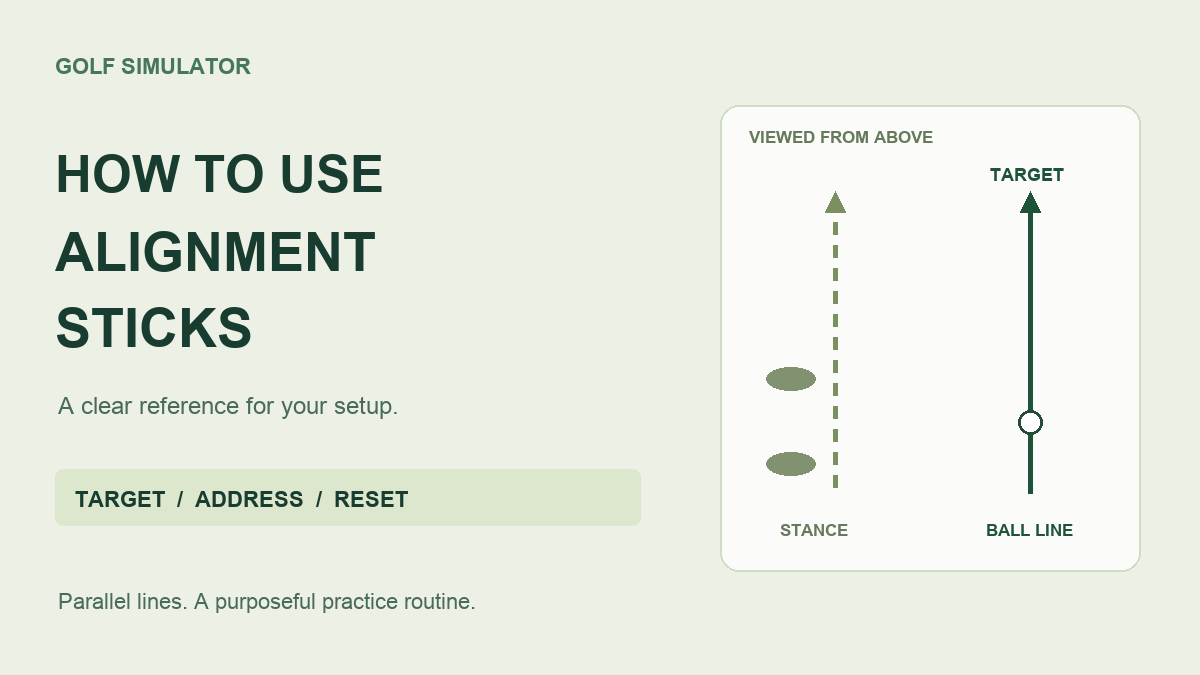
Think of the target direction and stance direction as parallel railway tracks. The ball-to-target line is one track. The reference beside your feet is the other. PGA instruction uses this relationship to distinguish aiming the clubface toward the target from aligning the body alongside that direction. Do not rotate the stance stick until its far end points at the same flag as the ball line. That would make the two references converge.
For a right-handed golfer in this neutral setup, the stance reference sits to the left of the ball-to-target line when viewed from behind the shot. For a left-handed golfer, it sits to the right. The relationship remains parallel in both cases. Place the rods for a static setup check, keeping them out of the intended club and ball travel. If a rod was used directly on the ball line to establish direction, remove it before hitting.
Parallel Lines, Different Positions
Right-handed example · viewed from above · target is ahead
Check the Address Position Before the Shot
With the references established, set the clubface for the intended target direction and take your address position. Check the relationship between the foot line and the ground reference. Do not assume that lining up the shoes has automatically organized everything above them. PGA coach Brendon Elliott's alignment guidance also considers the body's relationship to the target reference after the clubface has been aimed.
Keep this first stage a check rather than a swing drill. Step away and look at the arrangement again if something appears inconsistent. You are trying to establish a starting position you understand, not discover how many adjustments can be made while standing over the ball. A coach or a carefully positioned photograph can help clarify a repeated setup question. Avoid drawing a precise conclusion from a casual image taken at an unknown angle.
| Reference | What It Helps You Check | What It Does Not Establish |
|---|---|---|
| Target direction | The intention for the shot | The result the ball must produce |
| Stance reference | Your address position relative to that intention | The moving club's path through impact |
| Ball-position reference | Where the ball sits within the chosen setup | One correct position for every club |
Use a Ball-Position Reference for a Static Check
An alignment rod can also help you notice whether the ball position has drifted. Titleist instructor Justin Parsons recommends establishing a baseline rather than allowing the position to wander unnoticed. For a static check, use a separate ground reference across the stance direction to identify the ball's position relative to your feet. Inspect the relationship without making a swing, then remove the crosswise rod before hitting. The reference records a position; it does not decide which position is right.
Keep the club and intended shot in the notes for that baseline. Cameron McCormick's official Titleist guidance distinguishes the setup for a teed driver from shots with fairway metals and hybrids off the turf. That is a useful reason not to copy one ball location across the bag. If you do not have a suitable baseline, establish it with a coach rather than selecting a position solely because it is easy to line up with a stick.
Titleist instructor Justin Parsons: consistent ball position
Titleist instructor Cameron McCormick: long-game setup differences
Keep Alignment Separate From Swing Path
Alignment describes the starting arrangement. Swing path describes the direction of the moving club through the strike. A ground reference can help organize the former without proving the latter. Titleist instructor John Kostis treats the clubface-to-path relationship as a separate part of shot shaping. That distinction matters when the ball still curves after you have checked the address position.
Do not keep rotating the sticks until one shot looks better and then assume the original problem is solved. You may have changed the intention without understanding the delivery. Record what you observed: the setup appeared consistent, the ball started in a particular direction, or the curve repeated. Those observations give an instructor a clearer question than 'the stick did not work.' Keep this basic exercise about references, and leave specialized path or plane drills to an appropriate coaching plan.
Titleist instructor John Kostis: clubface and path in shot shaping
Use a Short, Repeatable Practice Loop
A simple session can follow four checkpoints: choose the target, establish the references, check address, then reset. At first, repeat the setup without hitting. Step out between attempts so you practice finding the position again rather than remaining planted in one successful arrangement. I would keep the exercise small enough that you can explain what you are checking in one sentence.
Once the arrangement is understood and the hitting area is clear, use a short series of shots if the facility and equipment support it. Note whether you reproduced the intended setup, then step away and reset. Change only one part of the task at a time. Later, remove the sticks and attempt the same setup before checking it again. Treat this as a practical way to observe the routine, not a promise that a particular number of repetitions will change your scores.
A Simple Setup Practice Loop
Choose the target
Give the exercise one clear direction.
Establish the references
Give each ground reference a defined job.
Check address
Inspect the setup before making a stroke.
Reset
Step away and establish the setup again.
Return to the target decision when you change the task.
Respond to What You Actually Observe
The useful outcome is a more specific observation. You might discover that the reference was aimed incorrectly before you addressed the ball, that you changed your stance after the initial check, or that the ball position moved during the session. Those are different findings and should lead to different next steps. Repositioning every rod after every miss makes it difficult to know what changed.
Keep a short note of the club, target, reference arrangement, and repeated issue. There is no need to turn a basic setup check into a detailed equipment report. The aim is to preserve enough context to repeat the exercise or explain it to a coach. If the ground references remain consistent but the result is still unexpected, acknowledge that limit. A simple alignment aid should narrow a question, not become evidence for a diagnosis it cannot make.
| Observation | Useful Next Check | Avoid Assuming |
|---|---|---|
| Reference points away from the intended direction | Re-establish the target before addressing the ball | That the swing caused the setup error |
| Address position changes after the check | Repeat the setup and identify when it changes | That a different stick will solve the habit |
| Ball position drifts | Compare with the baseline for that club and task | That every club needs the same position |
| Setup is consistent but shots still curve | Seek a clearer assessment of the moving strike | That parallel rods guarantee straight flight |
Keep Home Practice Simple and Transferable
You can rehearse the address-position routine indoors without hitting a ball, provided there is appropriate space to hold the club and move into position. Establish a visual target direction, perform the static checks, and put the rods away afterward. Do not add a swing merely because the address position fits in the room. The available clearance and containment are separate requirements.
In a simulator area, preserve the monitor's documented target reference rather than choosing a new direction because a screen edge looks convenient. If the practice goal is putting, use the mat's intended line and a separate putting routine instead of assuming a full-swing setup should be copied unchanged. Keep the task specific to the equipment and shot. The best next step is often a clearer reference, not more sticks or a more complicated station.
Frequently Asked Questions
Do I need two golf alignment sticks?
Two make separate references easier to compare, but a single rod can still mark one part of the setup. Choose the quantity around the exercise rather than adding equipment without a purpose. For the basic parallel-reference check, understand what each line represents before deciding whether another rod would help.
How do left-handed golfers use the same method?
Mirror the golfer's position around the ball-to-target line while preserving the parallel relationship. Viewed from behind the shot, a neutral left-handed stance reference sits to the right of the ball line. You do not need to aim both references at the same distant point.
Should I use the same ball position with every club?
Do not assume one position applies throughout the bag. The club and intended shot matter, and a teed driver setup differs from many shots played off the turf. Use the rod to check an appropriate baseline rather than allowing its placement to prescribe the baseline for you.
Can alignment sticks fix a slice?
They can help you inspect setup references, but a curved shot involves the moving strike as well. A consistent address position does not prove the clubface and path were delivered as intended. Use repeated observations to guide a coaching question rather than treating the sticks as a guaranteed correction.
Can I practice without hitting golf balls?
Yes. Choosing a target, establishing references, taking address, and stepping away to reset can all be rehearsed without a stroke. That is a useful starting point when you want to understand the arrangement. Keep adequate space for the club and avoid turning a static check into an unplanned indoor swing.
Are longer alignment sticks always better?
No. They need to provide a clear reference for the intended exercise and remain practical to carry and position. A longer rod does not automatically produce a more accurate setup. Choose a suitable format, keep it outside the strike area, and focus on what the reference is meant to show.
Give Each Stick One Clear Job
Start with a defined target and a simple reference arrangement. Check the address position, use a separate ball-position reference only when it answers a clear question, and remove equipment from the strike area before hitting. Repeat the routine deliberately and distinguish what you observed from what you inferred. Alignment sticks are most useful when they make a specific setup question easier to see and discuss, rather than promising to solve the whole swing.