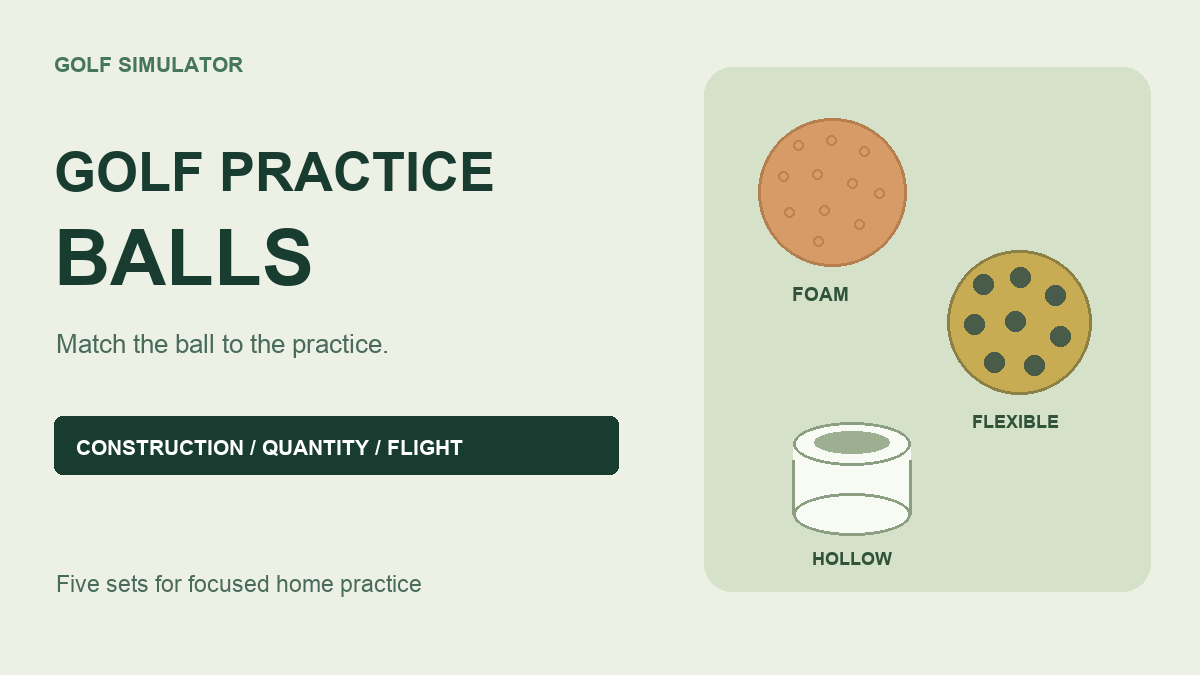
5 Best Golf Practice Balls for 2026
Golf practice balls make the most sense when they help you fit a useful session into the space and time you have. A bag of lightweight balls can support a short target drill, give you enough repetitions before the next collection trip, and keep a practice kit easy to carry. The choice gets less obvious when foam spheres, flexible plastic designs, and hollow cylinders all appear under the same label. I would choose around the exercise first, then compare the construction, quantity, and storage details. A ball for a short chipping routine has a different job from the one you use to establish your normal seven-iron distance.
The five options here are selected for home and limited-flight practice, with attention to their exact pack sizes and useful design differences. The aim is to find a set you will actually use, rather than to pretend every practice ball feels or flies identically. Quantity matters when you want to hit a small batch before retrieving it. Material and shape matter when choosing the exercise and planning the landing area. If a launch monitor is involved, check its ball requirements separately. These training products deserve to be judged on their practice role, not treated as automatic substitutes for regulation balls in measured simulator sessions.
In this guide
Which Practice Balls Fit Your Routine?
Choose GoSports for a sixteen-ball foam set with a storage tote, or Callaway for a smaller nine-ball package with a mesh bag. JAYA supplies twenty foam balls in a pastel assortment. SKLZ Impact is the choice for a pop-back design, while BirdieBall suits a more open practice area where its distinctive cylinder flight is part of the exercise.
Pick 1 of 5
1. JAYA Foam Golf Practice Balls
Best Colorful Foam Pack

- 20 foam practice balls
- 41 mm diameter
- Dimpled surface
- Assorted macaron colors
Pros
- Twenty balls per set
- Lightweight foam format
- Distinct pastel color assortment
- Dimpled surface
- Simple limited-flight practice setup
Cons
- Not intended for regulation-distance calibration
Specifications
| Feature | Specification |
|---|---|
| Quantity | 20 balls |
| Construction | Foam |
| Diameter | 41 mm |
| Surface | Dimpled |
| Color | Macaron assortment |
Our Detailed Review
A Useful Batch for Short Practice Sessions
JAYA is the set I would choose for a simple batch of target practice without building a complicated kit around it. The 20-ball pack gives you enough balls to establish a short sequence before walking out to collect them. That is a useful middle ground when you want several repetitions but do not need a large bucket. The foam construction suits its limited-flight practice role. Choose a target and an appropriate landing area, then keep the session focused on the exercise rather than trying to turn every shot into a distance test.
A Foam Format with a Familiar Surface
Each ball has a 41 mm diameter and a dimpled surface. Those are useful details for understanding the actual product rather than assuming all foam balls are identical. The familiar surface does not make the flight or impact feel interchangeable with your usual course ball. I would use this set for a repeatable short practice routine, then return to regulation balls when checking normal carry distances. Keeping those purposes separate lets a straightforward foam pack do its job without asking it to provide measurements it was not designed to establish.
Choose the Set for Its Simple Role
The macaron color assortment gives this set a softer visual style than the usual single-color practice pack. That can make it appealing for a shared home kit, although visibility will depend on the background where the balls land. Keep a small container with the set to make collection and storage straightforward. Buy JAYA for the twenty-ball quantity and simple foam format. It is an easy choice when those details match the routine and you care more about a manageable practice batch than elaborate extras.
Pick 2 of 5
2. Callaway HX Soft Flight Practice Balls
Best Small Pack with Bag

- Nine orange foam balls
- HEX dimple pattern
- Limited-flight design
- Mesh carry bag included
Pros
- Compact nine-ball quantity
- Included mesh carry bag
- Consistent orange color
- HEX dimple surface
Cons
- Fewer repetitions before collection than larger packs
- Not a regulation-distance substitute
Specifications
| Feature | Specification |
|---|---|
| Quantity | 9 balls |
| Construction | Soft-flite foam |
| Surface | HEX dimples |
| Color | Orange |
| Storage | Mesh carry bag |
Our Detailed Review
A Small Set That Stays Organized
Callaway HX Soft Flight is my pick for a small practice set that comes ready to keep together. This version contains nine orange balls, a sensible quantity for a deliberate series of shots followed by a collection break. The mesh carry bag is the practical extra that makes the package appealing. You can put the whole set away after the session instead of finding loose balls in a golf bag or drawer. It suits someone who wants a compact routine rather than a large-volume practice bucket.
HEX Dimples on a Foam Practice Ball
The soft-flite foam has Callaway’s HEX dimple pattern, giving the ball a distinct surface while retaining its reduced-flight practice role. I would choose it for a short target exercise where consistency of setup matters more than reproducing a full-distance shot. Keep the same target and type of swing for the small batch so the session stays purposeful. The familiar golf-ball shape is convenient, but the foam construction remains the relevant distinction when deciding what the resulting flight can tell you.
Choose It for a Deliberate Nine-Shot Routine
Against JAYA’s twenty-ball pack and GoSports’ sixteen, this nine-ball set favors compactness over uninterrupted repetitions. That is a useful tradeoff when you want to retrieve a small number of balls and reset the exercise rather than continue hitting indefinitely. Choose the larger GoSports pack when carrying more balls and a storage tote matters. Choose Callaway when nine balls are enough and you value a single orange color with a straightforward bag. I would buy this version for its manageable size, not simply because the logo is familiar.
Pick 3 of 5
3. GoSports Foam Golf Practice Balls
Best Foam Pack with Tote

- 16 foam practice balls
- Multicolor assortment
- Dimpled surface
- Storage tote included
Pros
- Sixteen balls for longer batches
- Included storage tote
- Multicolor set
- Dimpled limited-flight design
Cons
- Does not establish regulation-ball carry distances
Specifications
| Feature | Specification |
|---|---|
| Quantity | 16 balls |
| Construction | Foam |
| Surface | Dimpled |
| Color | Multicolor |
| Storage | Included tote |
Our Detailed Review
A Balanced Pack for Regular Practice
GoSports offers the combination I would look for in a regular home-practice kit: a useful quantity and somewhere to keep it. The 16-ball pack provides more shots between collection breaks than the nine-ball Callaway set, while the storage tote keeps the package organized afterward. That is a sensible arrangement for moving between a practice area and a cupboard or car. It also keeps the purchasing decision simple. You are buying a manageable batch of foam balls and the container to store them together.
Keep the Ball Type Consistent
The dimpled foam construction is designed for limited flight, and the multicolor assortment distinguishes this version from a single-color pack. Use the colors in whatever way makes the session easier to organize, such as reserving a few balls for the final group of shots. The manufacturer gives an approximate individual weight of 9.5–10.5 grams. That describes the lightweight practice format, not an equivalence to a regulation golf ball. I would keep one ball type within an exercise so changes between different practice designs do not complicate the comparison.
Choose the Tote and Useful Quantity
The included tote is the deciding feature against JAYA when storage convenience matters more than four additional balls. Against Callaway, GoSports gives you a larger batch while retaining a dedicated container. That makes it my straightforward recommendation for someone who expects to practice regularly and wants the set ready to pick up and put away. Choose it for the complete sixteen-ball package. A different construction, such as SKLZ’s pop-back design or BirdieBall’s cylinder, makes more sense only when that particular format serves the exercise you want to do.
Pick 4 of 5
4. SKLZ Impact Golf Practice Balls
Best Pop-Back Practice Design

- 12 yellow-and-black balls
- Regulation-sized training format
- 100% EVA material
- Pop-back limited-flight design
Pros
- Flexible pop-back construction
- Twelve-ball practice batch
- Two-tone surface
- Mesh carrying bag
Cons
- Training flight differs from regulation balls
- No fixed maximum distance established
Specifications
| Feature | Specification |
|---|---|
| Quantity | 12 balls |
| Material | 100% EVA |
| Size | Regulation-sized |
| Design | Pop-back; limited flight |
| Color | Yellow and black |
Our Detailed Review
A Different Construction for the Shortlist
SKLZ Impact is the alternative I would consider when a plain foam sphere is not the format you want. Its pop-back construction uses 100% EVA, with a flexible training design rather than a conventional course-ball structure. The pack contains twelve, which is a practical batch for a short routine without moving into bulk quantities. The reason to choose it is the construction itself. It adds a different option to the shortlist, rather than competing only on the number of balls in the package.
Regulation Size with a Training Role
The balls are regulation-sized and have a yellow-and-black design. That familiar size can be useful at address, while the two-tone surface makes their orientation visible. Neither detail turns them into regulation-weight or regulation-flight balls. A mesh carrying bag keeps the twelve limited-flight trainers together between sessions. I would use them consistently for the selected exercise instead of mixing them with other designs mid-session, particularly if I wanted to compare where a series of shots landed.
Choose It for the Pop-Back Format
Choose SKLZ when the pop-back design is the feature you specifically want, with a dozen balls as a manageable set. GoSports is the simpler choice when the priority is sixteen conventional-looking foam balls and a tote. BirdieBall asks you to adopt a much more distinctive cylinder format. SKLZ sits between those choices in its familiar round profile and different construction. I would buy it for that combination, while treating wear as something to inspect over time rather than accepting an absolute promise that any practice ball is indestructible.
Pick 5 of 5
5. BirdieBall Practice Golf Balls
Best Hollow-Cylinder Practice Ball

- 12 hollow polymer cylinders
- Limited-flight spin reference
- White with printed logos
- Standard dozen; accessories separate
Pros
- Distinct hollow-cylinder design
- Spin-based flight reference
- Twelve-piece practice set
- Works from suitable grass without a StrikePad
Cons
- Needs more open space than short indoor drills
- Avoid use below 45°F; retire cracked balls
Specifications
| Feature | Specification |
|---|---|
| Quantity | 12 |
| Construction | Hollow polymer cylinder |
| Color | White with printed logos |
| Typical Flight | About 40 yd with a 6-iron; varies |
| Care | Do not strike below 45°F or when cracked |
Our Detailed Review
A Different Kind of Limited-Flight Practice
BirdieBall is the specialist option I would choose when watching the practice flight is an important part of the exercise. The hollow polymer cylinder is deliberately different from the foam spheres elsewhere in this guide. Its design supports a limited-flight spin reference, with the cylinder compressing at impact and returning toward its circular shape. The standard twelve-pack gives you a complete batch to work with. Buy it because you want that particular practice format, not because the word ball suggests another interchangeable foam option.
Plan the Space Around the Shot
The manufacturer describes roughly 40-yard flight with a six-iron as an average, with distance affected by the club, swing speed, and wind. Driver shots using the separate Velocity Tee can reach sixty yards, so forty yards is not a hard boundary. The 45°F temperature limit also matters for when you plan to practice, and cracked cylinders should be retired. Those details point toward an appropriate open practice area. A StrikePad is optional, but neither it nor the tee belongs to this standard dozen package.
Choose It When the Flight Is the Point
Choose BirdieBall over Callaway or GoSports when you have the space and want to learn the hollow-cylinder format. Choose the simpler foam sets when the session is mainly a short target drill and packing convenience matters more. BirdieBall can be used from suitable grass without buying a StrikePad, which keeps the basic setup straightforward. I would reserve it for a routine where its flight is useful to observe. It is a distinct practice tool, and that clear difference is a better reason to buy it than expecting every golf-training product to behave alike.
How to Choose Golf Practice Balls
Match the ball to the exercise and the available landing area. After that, compare the pack size and construction details that will affect every session.
Practice Goal
Decide what you want to learn from the session. Hitting a short target, rehearsing contact, and measuring full-distance shots are different tasks. A lightweight practice ball can be useful for the first two without behaving like your usual course ball. Choose a repeatable exercise and keep your expectations tied to it. If you want carry distances or club gapping, use the ball type required by the measurement system. That keeps an accessible home-practice tool from becoming the basis for misleading distance comparisons.
Material and Shape
Foam, flexible perforated designs, and hollow cylinders are distinct choices. Look beyond the word practice and understand what the ball is made from and how it is meant to be struck. A conventional-looking dimpled sphere may feel familiar to address, while a cylinder can require a different setup. Material also affects what care instructions apply. Choose a format whose intended use you understand, rather than assuming a more unusual design is better or that every soft-looking product behaves the same way.
Flight and Landing Area
Reduced flight still needs an appropriate landing area. Check the manufacturer’s guidance for the particular ball and the type of shot you intend to play. A short chip and a full swing do not create the same space requirement, and an advertised typical distance is not necessarily a hard maximum. Choose the area before choosing the ball, with clear surroundings and enough room for the club. A target or suitable net can make the session more organized when the product and exercise call for one.
Quantity and Collection
Think about how many balls you want to strike before collecting them. A modest pack is convenient for a deliberate series of shots, while a larger quantity can reduce interruptions during shared practice. More balls also mean more to locate and put away afterward. A tote or mesh bag is useful if the kit moves between home and a practice area. Pick a quantity that matches the routine, and consider the color against the actual landing surface rather than judging visibility from the product photograph alone.
Condition and Storage
Treat practice balls as equipment you inspect, not something that lasts indefinitely because it is inexpensive. Follow any material-specific temperature or storage guidance and replace damaged examples when the instructions call for it. Keep the set together so missing balls do not gradually turn a useful batch into a handful. A dry storage container can also make packing and collection simpler. The right choice is one you can maintain easily between sessions, with care requirements that suit where and when you practice.
Golf Practice Ball Comparison Table
| Product | Best For | Quantity | Construction | Design | Storage |
|---|---|---|---|---|---|
| JAYA Foam Golf Practice Balls | Best Colorful Foam Pack | 20 | Foam | 41 mm; dimpled; pastel assortment | Use a suitable container |
| Callaway HX Soft Flight Practice Balls | Best Small Pack with Bag | 9 | Soft-flite foam | HEX dimples; orange | Mesh carry bag |
| GoSports Foam Golf Practice Balls | Best Foam Pack with Tote | 16 | Foam | Dimpled; multicolor | Storage tote |
| SKLZ Impact Golf Practice Balls | Best Pop-Back Practice Design | 12 | 100% EVA | Regulation-sized; pop-back; yellow/black | Mesh carrying bag |
| BirdieBall Practice Golf Balls | Best Hollow-Cylinder Practice Ball | 12 | Hollow polymer cylinders | White with logos; limited-flight spin reference | Standard dozen box |
How We Evaluated the Practice Balls
The comparison focuses on the differences that change the way a practice set gets used. Quantity, construction, surface design, and storage arrangements matter because they affect setup, repetition, and collection. I also distinguish the intended exercise from broad promises about realistic feel. A ball can be useful for short target work without reproducing the carry distance of a regulation ball. The recommendations reflect those practical roles rather than treating every training product as a direct replacement for the same equipment.
Exact versions receive particular attention. A larger pack, a different color assortment, or an included carry bag can change the appeal of an otherwise similar product. For less conventional designs, the setup and flight guidance are part of the buying decision too. The aim is to explain what you need around the product, including a suitable landing area and any separate accessory, so that the set fits naturally into the session you have in mind.
Claims about reduced flight are considered alongside their limits. A typical distance does not establish a guaranteed boundary, and a regulation-sized shape does not establish regulation-ball performance. Launch-monitor suitability is handled through the relevant device manufacturer’s guidance rather than inferred from a practice-ball description. That leaves a straightforward standard for choosing: understand the exercise, select an appropriate format, and use the results in that context. The most useful pack is the one that supports that routine consistently.
Frequently Asked Questions
Are foam or plastic golf practice balls better?
They serve different preferences and exercises. Compare the exact construction, intended flight, quantity, and setup rather than choosing from the material label alone. Foam spheres offer a familiar shape, while flexible or hollow designs can behave differently. The better option is the one that fits your practice area and gives the kind of feedback the exercise calls for.
Can you use these practice balls with a launch monitor?
Check the exact monitor first. Garmin cautions that foam, plastic, and other limited-flight balls can produce inconsistent or absent readings on its Approach R10 and G80. Rapsodo says the MLM2PRO does not capture foam or plastic balls. Use the supported ball type for measured sessions rather than assuming a product marketed for home practice will work with your device.
Garmin: practice balls with Approach R10 and G80
Rapsodo: MLM2PRO ball compatibility
Do limited-flight practice balls tell you your normal carry distance?
No. Their purpose is to reduce or alter flight, so the distance they travel is not a direct measure of what your normal golf ball would do. Use them for the exercise they support, such as target practice or contact rehearsal. Check normal carry distances separately with the appropriate ball and a suitable measurement setup.
How many golf practice balls do you need?
Choose enough for a useful batch before retrieval. A smaller pack can suit a focused series of shots, while a larger quantity is convenient for shared sessions or fewer collection breaks. Balance that against the time spent finding and storing them afterward. A practical container can be as useful as extra balls when the set moves between locations.
Final Thoughts
Choose golf practice balls for the session you want to repeat. A manageable quantity, an appropriate construction, and a convenient way to collect and store them will matter more than a sweeping promise of realistic performance. Keep the practice goal clear and make sure the ball’s intended use fits the available space. That is how a simple accessory becomes a useful part of the routine instead of another pack that spends most of its time in a cupboard.
I would keep lightweight practice work and measured distance work distinct. Use a training set to make a suitable exercise easier to organize, then use the required ball when checking normal shot numbers. There is no need to demand both jobs from the same product. Buy the pack whose format and quantity suit your home practice, look after it according to its instructions, and let the consistency of the routine justify the purchase.